
The Iron Age
A Basket of Stocks for the Robotics and Automation Era

The AI trade has evolved in ways most investors never anticipated.
That’s the point of great investing. You’re not supposed to see it coming with the crowd.
The first wave was obvious in hindsight. Compute. Nvidia. GPUs. The race to train models that had never existed before. That trade ran faster than almost anything in the history of public markets.
Then power. AI data centers don’t run on good intentions. They run on electricity. Massive amounts of it. Power companies that hadn’t seen real demand growth in a decade suddenly had years of backlog. That wave ran.
Then memory. Running these models at scale, not training them, actually deploying them, required a very specific kind of memory. High bandwidth. These large LLMs were useless without massive amounts of memory to fuel context and inference. The market eventually connected those dots.
Then photonics. Getting data between chips, between servers, between buildings, fast enough for all of this to function, required light. Glass instead of copper. That wave is still running as you read this.
Each theme undiscovered at the start. Each one consensus by the time the next wave surfaced.
Now ask the obvious question.
What is all of this being built for?
There is no point reaching the pinnacle of artificial intelligence if it stays locked inside a server farm in Virginia. ChatGPT answering questions was the proof of concept. A remarkable one. But not the destination.
The destination is the physical world.
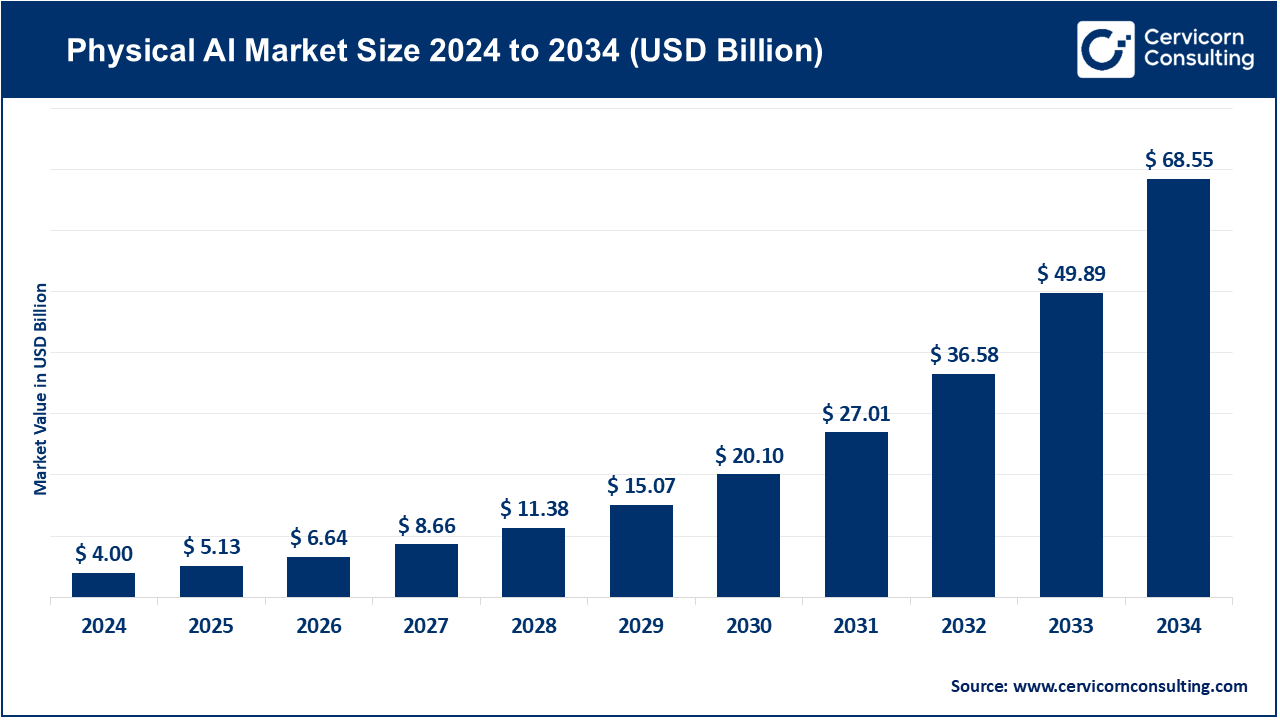
Robots moving products through warehouses. Surgical systems operating with precision no human hand can match. Assembly lines running without labor. Autonomous vehicles navigating cities without a driver. Agricultural equipment farming fields at 3am without anyone watching.
This is what all of the compute, all of the power, all of the memory, all of the photonics was being built toward.
Think about what happened with computing itself. The mainframe in the 1940s was revolutionary, but it sat in a room and institutions barely understood it. Then computers reached desks. Then laps. Then pockets. Each step compressed more intelligence into more physical contact with more human beings. One billion people went from no computing device to a supercomputer in their pocket in thirty years.
AI is following the same arc.
Right now it lives in data centers. It speaks to you through a screen. That is the mainframe era of artificial intelligence.
Physical AI is the smartphone era.
The moment intelligence moves from the cloud into the machine that picks your package, drives your car, performs your surgery, assembles your components. Every robot deployed is a contact point between AI and the physical world. At scale, this is not a niche application.
It is the entire point.
We have been here before.
When we first initiated RRX at $143, the narrative was simple. A boring industrial company sitting directly in the path of the robotics and automation wave. The market labeled it a gear and motor company. We saw it as the mechanical infrastructure of physical AI.
We closed that position at $220. Over 50% in a matter of months.
The thesis was right. The entry was right. The exit was right.
Now we are coming back. Not just to RRX, but to the entire supply chain that surrounds it. Because what RRX confirmed is that the market is systematically mispricing physical AI companies by labeling them as the thing they used to be rather than the thing they are becoming.
That mispricing has not gone away. It has spread across an entire supply chain.
The supply chain that makes physical AI real is sitting at industrial multiples while a technology transformation loads underneath it. The rare earth materials, the precision components, the vision systems, the force sensors, the assemblers, the infrastructure connecting all of it.
That gap is the investment.
These are ten companies building the physical AI economy. Most of them are still priced as something they used to be.
The Supply Chain
Before the names, the map.
Physical AI is not one product. It is a cascade of layers, each one enabling the next.
Materials feed into components. Components get assembled into systems. Systems get deployed into operations. Infrastructure connects all of it.
Every humanoid robot, every automated warehouse, every autonomous vehicle is the output of this entire chain functioning together. Remove one layer and the whole thing stops.
That is the investment thesis. Not the robot. The layers underneath it.
